How to verify a New York City tow company is legitimate
New York City licenses the companies that tow from private property, which trips people up. Here is what you can actually check, and it takes five minutes.
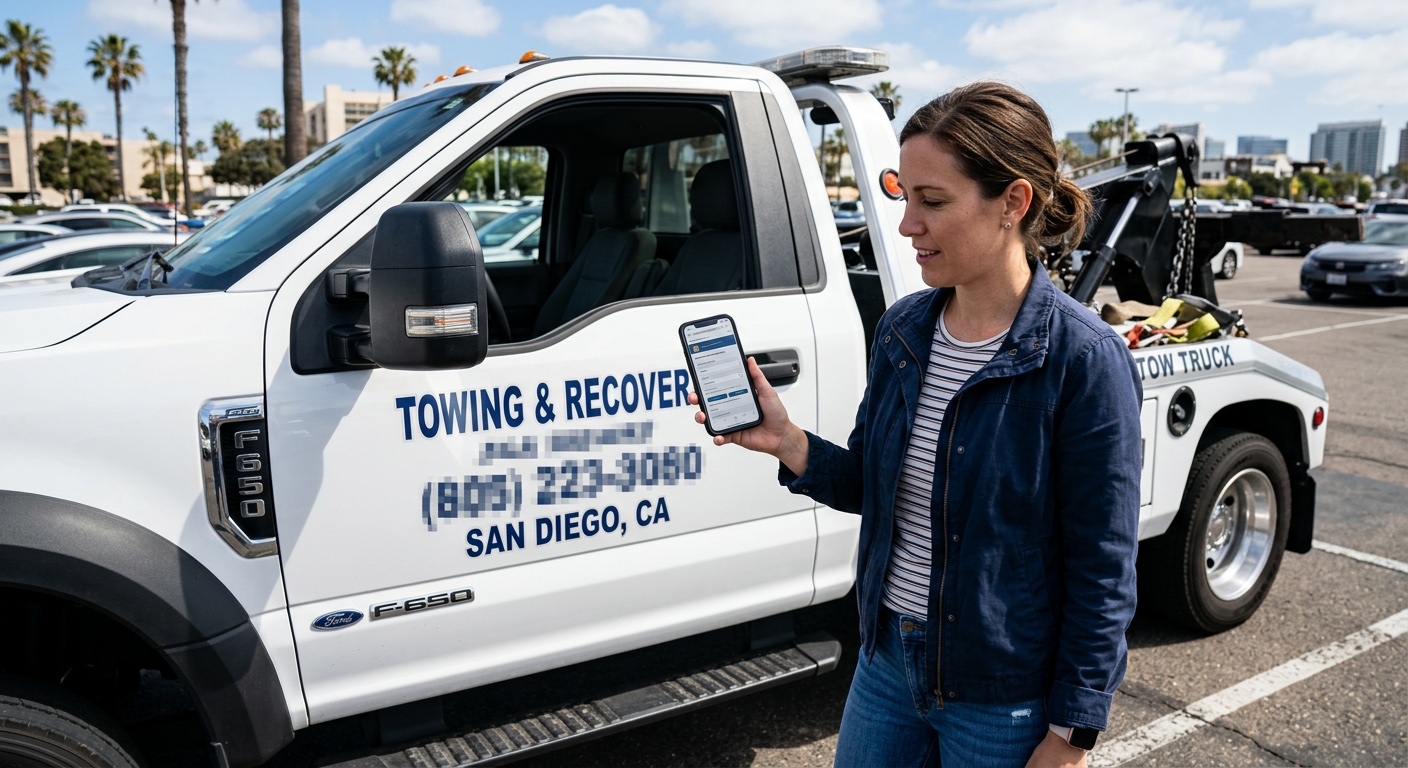
What you'll learn
- Which tow companies New York City actually licenses, and which it does not
- What the Department of Consumer and Worker Protection requires of a private-property tow operator
- Why the NYPD pound fees are published, and how to use them as a reference point
- What to ask for on scene before you let anyone hook your vehicle
- Where to complain, and to which body, when something goes wrong
Step by step
- Ask who ordered the tow. A tow you requested, an NYPD or Sheriff tow, and a private-property tow are three different things with three different sets of rules.
- Ask for the price in writing before the truck rolls. For a tow you ordered, that number is the whole agreement.
- For a private-property tow, ask for the operator's New York City DCWP towing license. A licensed business should be able to give it.
- Look at the lot. Under DCWP Rule 6 section 2-377 a compliant sign must sit at each entrance and along the perimeter no more than 250 feet apart, stating the operator, the fees and the hours.
- Ask for a receipt. You are entitled to one, and DCWP takes complaints about overcharging and signage through 311.
- Photograph the scene before anything moves, including the sign or the absence of one.
New York City does not issue one license that covers every tow. What it does license, specifically, is the businesses that tow from private property, under Administrative Code 20-496 through the Department of Consumer and Worker Protection, with fingerprinting for owners, officers and major stockholders. If you are dealing with a private-lot or driveway tow, that license is a real thing you can ask about. An NYPD parking tow and a Sheriff scofflaw tow are city functions, not licensed private companies.
Start with the right question
People usually ask whether a tow company is licensed. In New York City the more useful question is what kind of tow this is, because the answer decides whether a license exists to check at all.
Step 1: work out which of three things happened
- You called them. You chose the company and agreed the price. Your protection here is the quote, in writing, before the truck rolls.
- The NYPD or the Sheriff towed it. An NYPD parking tow goes to the borough tow pound and the fees are published. A Sheriff scofflaw boot-and-tow is a Department of Finance matter tied to unpaid judgment tickets. You did not choose, and there is no private-company license in play.
- A property owner had it towed. This is the one New York City licenses. A private-property tow, from a lot, an apartment complex or a blocked driveway, is regulated under Administrative Code 19-169.1 and may only be done by a business holding a DCWP towing license.
Step 2: check the operator against the rules
You do not need a database for this. The rules themselves give you a checklist you can run on the spot.
- A DCWP towing license. Ask for it. A licensed business should be able to give the license number.
- A compliant sign on the property, under DCWP Rule 6 section 2-377: at each entrance and along the perimeter no more than 250 feet apart, at least 12 by 18 inches, top 6 to 8 feet above the ground, luminescent, naming the operator and stating the fees and hours.
- The hookup rule honored, under 19-169.1: if you arrive before the car is removed and it is connected to the apparatus, it must be disconnected.
- The capped rate: up to $125 for removal plus the first three days, then $15 a day, with a $62.50 drop fee if you catch the driver before removal.
- The distance limit: stored within city limits and no more than 10 miles from where it was taken.
- A receipt for what you paid, which is also what you attach to a DCWP complaint.
Step 3: use the NYPD pound fees as a benchmark
The city publishes what the NYPD charges to release a towed vehicle: $185 for a regular tow, $370 for heavy duty at 8,000 pounds or more, and $20 per night storage, reclaimed within 10 days. Those are not private rates and they do not bind a private company, but they tell you what the city charges for the same physical work, which is a useful reference when a private number sounds wrong. A DCWP-licensed private operator is separately capped at $125 for removal and the first three days, so a bill well above either figure is worth questioning.
Step 4: check the equipment against the job
The single most common real-world problem is not a fraudulent company, it is the wrong truck. Many owner's manuals call for a flatbed on an all-wheel drive vehicle, an electric vehicle, a lowered car or anything that will not roll, so read the manual for your model and ask the assigned operator to follow it. If a wheel-lift truck arrives for an electric vehicle, that is the moment to stop and ask.
Step 5: know where to complain
| Body | Contact | What it handles |
|---|---|---|
| NYC 311 | 311, the NYC311 app, or the NYCServ towed-vehicle lookup | Locating a towed or abandoned vehicle, and filing a private-tow complaint with DCWP |
| Department of Consumer and Worker Protection | Through 311 | Private-tow licensing, signage, overcharging and the hookup rule |
| NYPD tow pounds | Bronx 718-585-1385, Brooklyn Navy Yard 718-237-3300, Queens College Point 718-359-6200 | A parking tow, the release fees and the 10-day reclaim window |
| Department of Finance | Through 311 | A parking summons dispute, and a Sheriff scofflaw boot-and-tow tied to unpaid tickets |
If something has already gone wrong
- Keep the receipt. For a private tow it is both your proof of payment and what you attach to a DCWP complaint.
- Write down times. Log when you first reached, or could not reach, the operator, and note whether the hookup rule was honored when you arrived.
- Ask for the written estimate. Under New York Lien Law section 184 the operator's lien is capped at any written estimate given, so that estimate limits what they can hold the car for.
- File with the right body. A private-tow complaint goes to DCWP through 311. A parking summons dispute goes through the Department of Finance. Sending either one to the wrong place costs weeks.
Rather have a pro handle it?
Towing and roadside service across the five boroughs of New York City. One local line, taking calls around the clock.
Keep learning.
Jump-start a dead battery safely
Jumper cables are simple until you hook them wrong. Do it right and you'll avoid sparks, ruined electronics, and a tow you didn't need.
Change a flat tire on the side of the road
The difference between a 20-minute shoulder stop and an hour on the phone with a tow company is knowing where the spare and jack live before you need them.
What to do if you slide on ice or hit a flooded underpass
New York winters glaze bridges and ramps before flat streets, and a heavy rain fills a highway underpass faster than it looks. First step: stop making it worse.